Leaders in Eye care

NABH accredited

Zee healthcare leadership award

Awarded top eye centre

Awarded trusted eye centre

Awarded trusted eye centre
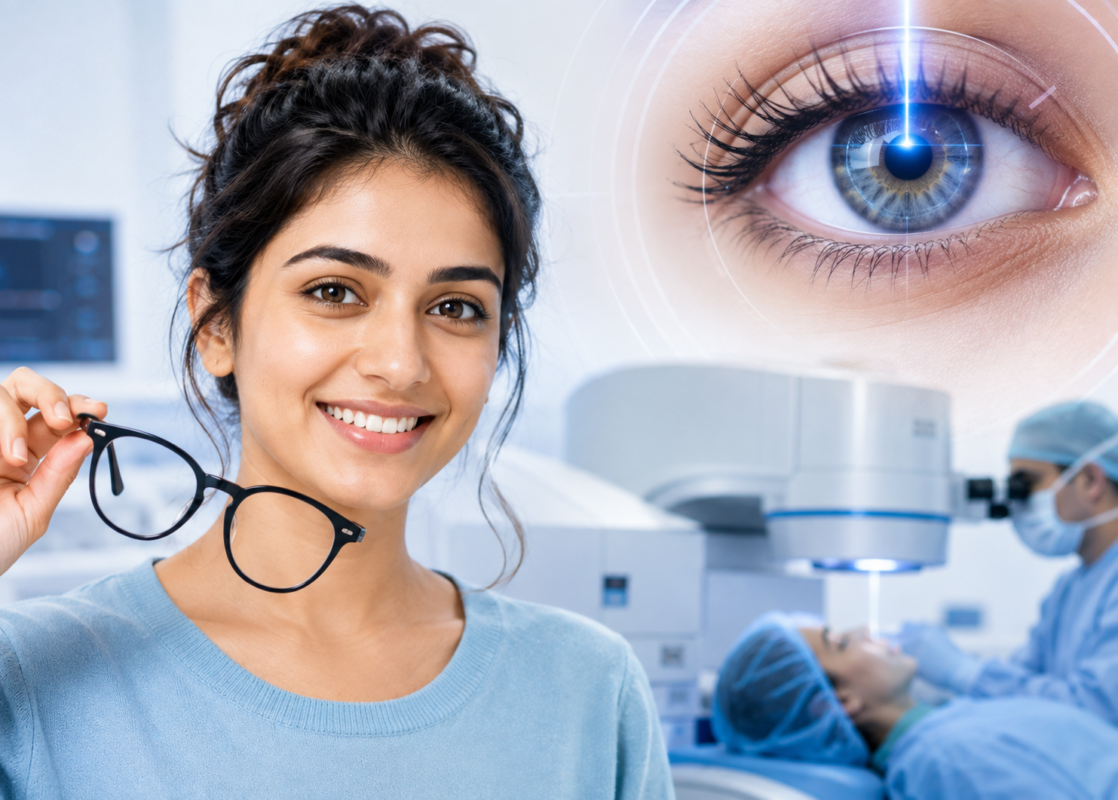
Understanding LASIK Eye Surgery
LASIK is a laser-based procedure that corrects the way your eye focuses light. The cornea — the clear, curved surface at the front of your eye — bends light onto the retina, and when it isn’t shaped quite right, that light lands slightly off target, causing the blurred vision glasses or contact lenses have been compensating for. LASIK gently reshapes the cornea itself, so your eye can focus correctly on its own.
It’s a quick outpatient procedure done under numbing eye drops, and most patients notice clearer vision within a day or two. Since it corrects the actual refractive error rather than just managing it, results typically last for years.
Will LASIK Remove My Specs?
LASIK has helped millions of people give up glasses and contact lenses for good, but it isn’t right for every eye. A proper screening is the only way to know for sure. As a general guide:

|
You must be |
You Should not be |
|---|---|
|
You are at least 18 years old and have generally healthy eyes. |
Pregnant or Breastfeeding Hormonal changes during pregnancy or breastfeeding can temporarily affect vision and eye power. |
|
Your spectacle or contact lens prescription has remained stable for at least 1 year. |
Some autoimmune diseases, uncontrolled diabetes, or other systemic health conditions may affect healing and LASIK suitability. |
|
Your corneal thickness and overall eye health are suitable for LASIK, as confirmed during your eye examination. |
Conditions such as severe dry eyes, thin or irregular corneas, keratoconus, retinal problems, glaucoma, or other eye diseases may make LASIK unsuitable. |

LASIK Treatment Options
Explore advanced LASIK procedures designed to correct vision and reduce dependence on glasses or contact lenses.
BLADE-FREE LASIK
- No Hospitalisation
- Minimally Invasive
- Quick Visual Recovery
- Minimal Discomfort
- Femtosecond + Excimer Laser
- Suitable for Common Refractive Errors
- Precise Vision Correction
- No External Lens After Recovery
- Return to Routine Activities Quickly
- Suitability Confirmed After Detailed Eye Evaluation
SURFACE LASER / PRK
- No Hospitalisation
- No Corneal Flap
- Gradual Visual Recovery
- Mild Discomfort During Recovery
- Excimer Laser Treatment
- Suitable for Selected Thin Corneas
- Preserves More Corneal Tissue
- Temporary Protective Contact Lens May Be Used
- Longer Healing Period Compared
- Suitability Confirmed After Detailed Eye Evaluation
ICL (EVO ICL)
- No Hospitalisation
- Implantable Lens Procedure
- Quick Visual Recovery
- Minimal Discomfort
- Collamer Lens Implanted Inside the Eye
- High Myopia & Selected Thin Corneas
- Corneal Tissue is Not Removed
- Lens Remains Inside the Eye
- Fast Recovery for Many Patients*
- Suitability Confirmed After Detailed Eye Evaluation
CONTOURA VISION LASIK
- No Hospitalisation
- Topography-Guided Laser Treatment
- Quick Visual Recovery
- Minimal Discomfort
- Excimer Laser with Corneal Mapping
- Customized Treatment Based on Corneal Topography
- Helps Correct Corneal Irregularities
- Designed to Improve Visual Quality
- Fast Return to Routine Activities
- Suitability Confirmed After Detailed Eye Evaluation
SMILE
- No Hospitalisation
- Flapless Laser Procedure
- Quick Visual Recovery
- Minimal Discomfort
- Femtosecond Laser
- Commonly Used for Myopia & Astigmatism
- Small-Incision Procedure
- Minimal Corneal Surface Disturbance
- Fast Return to Routine Activities*
- Suitability Confirmed After Detailed Eye Evaluation
Our Reviews
I used to struggle with glare and blurry vision after sunset. After Contoura Vision LASIK, my night vision improved drastically. The recovery was smooth and I resumed work in two days.
Frequently Asked Questions
LASIK, or Laser-Assisted In Situ Keratomileusis, reshapes the cornea — the clear front surface of your eye — so light entering the eye focuses correctly on the retina. This corrects blurred vision without needing glasses or contact lenses.
our surgeon uses a laser to reshape the cornea — the clear dome at the front of your eye — so that light focuses correctly on the retina. A thin flap is lifted, the laser adjusts the tissue underneath in a matter of seconds, and the flap is put back in place. No stitches, no injections.
Nearsightedness, farsightedness, and astigmatism — the three refractive errors responsible for almost all blurred vision that isn't caused by an underlying eye disease.
Glasses and contact lenses correct your vision temporarily, from the outside. LASIK changes the shape of the cornea itself, so the correction is built into your eye rather than sitting on top of it — which is also why the effect tends to last.
Broadly, adults above 18 with at least a year of stable eye power, healthy corneas, and no active eye disease. Corneal thickness matters a lot here, and it's only confirmed through a proper eye scan.
Yes — pregnant or breastfeeding women, people with autoimmune conditions like lupus or Sjögren's syndrome, and anyone with an existing corneal or retinal problem are usually asked to wait or explore other options.
A topography-guided procedure that maps your cornea's exact surface before treatment, allowing more customised correction. It's often preferred by patients who want minimal glare and halos, especially for night driving.
SMILE (Small Incision Lenticule Extraction) is a flapless, minimally invasive alternative performed through a very small incision. Recovery tends to be quicker, and it's frequently recommended for people with active lifestyles or a higher risk of eye trauma, including sportspersons.
It's suited to patients with thinner corneas who aren't ideal candidates for flap-based procedures. Recovery takes longer than LASIK, but it remains one of the safest options for borderline corneal thickness.
ICL (Implantable Contact Lens) isn't a laser procedure — a lens is implanted inside the eye rather than reshaping the cornea. It's usually recommended for very high refractive power or corneas too thin for laser correction.
Because comparing surgeons, technology, and pricing across Pune on your own eats up time most people don't have. We match you with vetted surgeons and accredited hospitals, walk you through a free consultation, and keep pricing transparent from the start — insurance coordination included where it applies.
No real pain during the procedure — some mild pressure, maybe. A bit of discomfort for a few hours afterward is normal and easily managed with the drops your surgeon prescribes.
Under an hour for the procedure itself, including prep. It's a day-care surgery, so there's no overnight stay involved.
Around 3 to 4 days if your job is desk-based. If your work involves physical strain or dust exposure, your surgeon may suggest a longer gap.
Usually, yes. Most surgeons treat both eyes in one sitting unless there's a specific reason to space them out.
Minimum is 18, and only once your power has held steady for a year. There isn't really a hard upper limit — it comes down to whether your eyes are otherwise healthy.
It depends on how well it's controlled and whether it's affected your eyes already. That's exactly what the screening is meant to catch.
It's best to wait. Hormonal shifts during pregnancy and breastfeeding can temporarily change your cornea's shape, which throws off the accuracy of the correction.
Day one, expect some grittiness and light sensitivity, though vision already starts improving within hours. By day two or three, most people are back to desk work. Week one is about protecting your eyes outdoors with dark glasses. By weeks two to four, normal activity resumes, though swimming and contact sports wait a bit longer. Full stabilisation usually lands somewhere between one and three months.
A next-day visit, then one around a week out, followed by monthly reviews for a couple of months. Exact schedule depends on your hospital's protocol.
LASIK involves a corneal flap; SMILE uses a small incision without one. SMILE can mean a slightly quicker return to activity, but which one's right depends on your eye's specific measurements, not personal preference alone.
Most standard health insurance policies treat LASIK as elective and don't cover it, though this varies by insurer. We can help you check what applies in your case.