
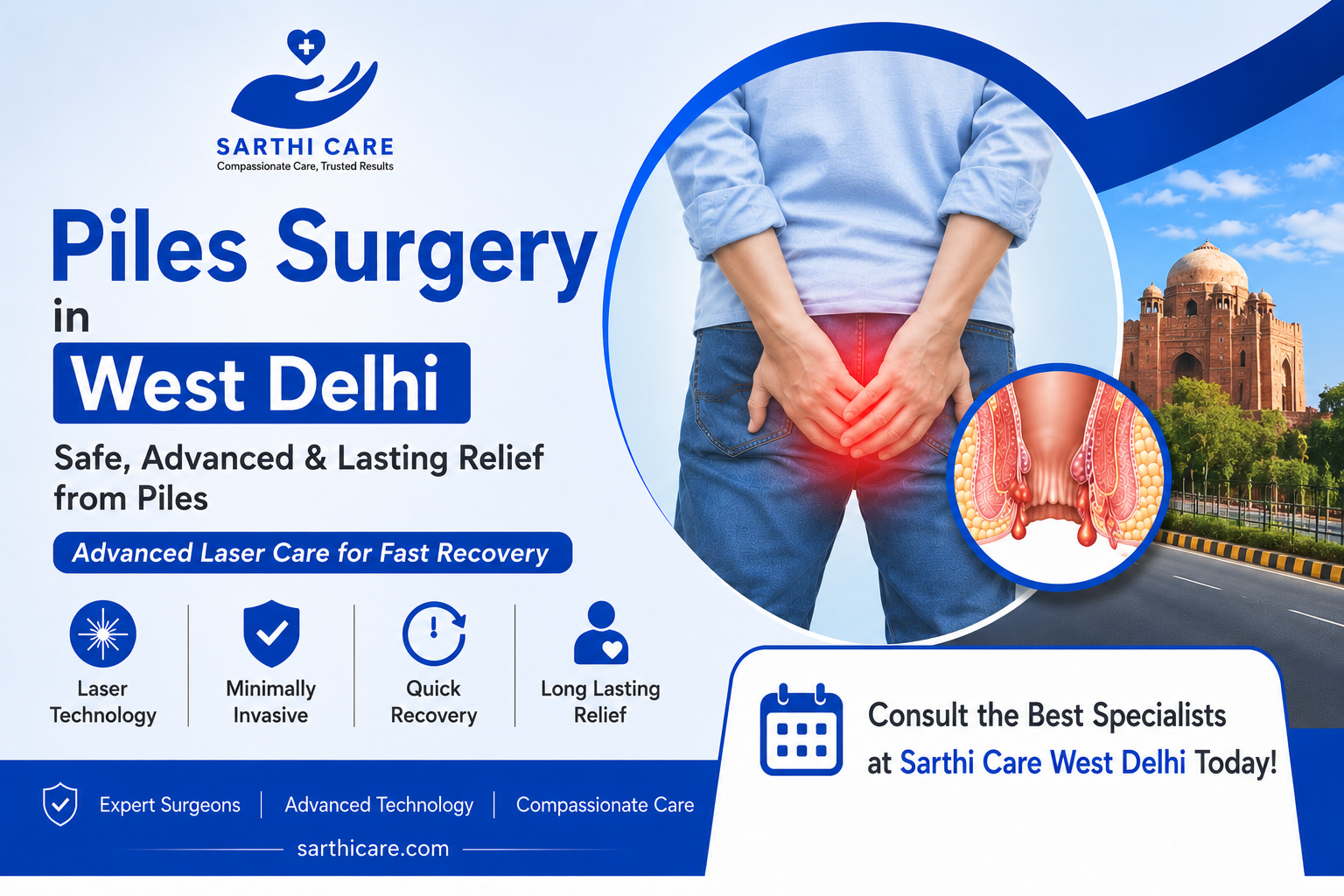
Piles can cause bleeding during bowel movements, itching, swelling, pain, and tissue that comes out of the anus. Mild piles may improve with dietary changes, medicines, and better bowel habits. However, persistent bleeding, repeated prolapse, severe pain, or symptoms that return after treatment may require a medical procedure or surgery.
Patients looking for piles surgery in West Delhi can consult Sarthi Care for evaluation and treatment planning. Depending on the type and grade of hemorrhoids, treatment may include rubber-band ligation, laser hemorrhoid treatment, hemorrhoidal artery ligation, or surgical hemorrhoidectomy.
Laser surgery is not automatically the correct treatment for every patient. The procedure should be chosen after confirming whether the piles are internal, external, thrombosed, or combined.
What Are Piles?
Piles, medically called hemorrhoids, are swollen vascular tissues inside or around the anus and lower rectum.
They are generally divided into two types:
Internal piles
Internal piles develop inside the rectum. They commonly cause bright-red bleeding during or after passing stool. Larger internal piles may come outside the anus during bowel movements.
External piles
External piles form beneath the skin around the anus. They may cause itching, soreness, swelling, and pain. If a blood clot forms inside an external pile, it is called a thrombosed hemorrhoid and can cause sudden severe pain and a hard lump.
Common factors associated with piles include:
- Chronic constipation
- Straining during bowel movements
- Spending excessive time on the toilet
- A low-fibre diet
- Pregnancy
- Obesity
- Repeated heavy lifting
- Age-related weakening of supporting tissues
Having these symptoms does not confirm piles. Anal fissures, fistulas, abscesses, polyps, and other bowel conditions may produce similar complaints.
When Should You Consult a Piles Surgeon?
Medical evaluation is recommended when symptoms do not improve with basic treatment or repeatedly affect daily life.
Consult a specialist when you experience:
- Recurrent bleeding while passing stool
- A lump that comes out during bowel movements
- Piles that must be pushed back manually
- Severe anal pain or swelling
- Repeated itching or mucus discharge
- A painful external lump
- Symptoms returning after previous treatment
- Difficulty sitting or working comfortably
Seek urgent medical care for severe anal pain with rectal bleeding, especially when it occurs with abdominal pain, fever, or diarrhea.
Rectal bleeding should not automatically be blamed on piles. A proper examination is necessary to identify the source.
How Are Piles Diagnosed?
A piles consultation normally begins with a discussion about bleeding, pain, prolapse, constipation, previous treatment, and current medicines.
The doctor may perform the following:
- Examination of the anal area
- Digital rectal examination
- Anoscopy
- Proctoscopy
External piles can often be identified through inspection. Internal piles may require a digital examination and a procedure that allows the doctor to inspect the anal canal and lower rectum.
Further bowel investigation may be recommended when the bleeding pattern is unusual, symptoms have changed or another colorectal condition needs to be excluded.
Grades of Internal Piles
Internal hemorrhoids are commonly classified according to prolapse:
- Grade 1: The piles remain inside the anal canal.
- Grade 2: They come out while passing stool but return on their own.
- Grade 3: They come out and must be pushed back manually.
- Grade 4: They remain outside and cannot be pushed back effectively.
Grade 1, Grade 2, and selected Grade 3 piles may sometimes be managed using medicines or office-based procedures. Surgery is more commonly considered for large external piles, combined internal and external disease, significant grade 3 prolapse, or grade 4 piles.
Current colorectal guidelines identify excisional hemorrhoidectomy as an effective option for selected patients with external piles or symptomatic combined Grade 3–4 disease.
Treatment Options Before Surgery
Not every patient needs an operation. Early or uncomplicated piles may improve through the following:
- Increasing dietary fibre
- Drinking adequate water
- Treating constipation
- Using stool-softening medicines when prescribed
- Avoiding straining
- Limiting time spent on the toilet
- Taking warm sitz baths
- Using short-term creams or suppositories when advised
Office-based procedures may include rubber-band ligation, sclerotherapy, or infrared coagulation.
Rubber-band ligation places a tight band around an internal pile to stop its blood supply. The tissue then shrinks and separates. It is a non-surgical option commonly considered for suitable internal hemorrhoids.
These methods may not adequately treat large external piles, extensive prolapse, or advanced combined disease.
Types of Piles Surgery in West Delhi
The surgeon selects the procedure according to the pile grade, symptoms, external component and previous treatment.
Laser piles treatment
Laser piles treatment uses controlled energy to shrink suitable haemorrhoidal tissue and reduce its blood supply. Certain laser techniques can be performed without creating a large external wound.
Possible benefits in selected patients may include:
- Limited blood loss
- Less disruption of surrounding tissue
- Daycare treatment in medically suitable cases
- Reduced wound-care requirements
- Earlier return to light activities than after some conventional operations
Laser treatment should not be described as completely painless, bloodless or recurrence-free. Anaesthesia controls pain during the procedure, but discomfort, swelling, discharge or mild bleeding can occur afterward.
Large external piles, extensive prolapse or combined internal and external haemorrhoids may require another procedure instead of laser treatment alone.
Haemorrhoidectomy
Haemorrhoidectomy involves surgically removing the affected haemorrhoidal tissue.
It may be recommended for:
- Large external piles
- Combined internal and external piles
- Advanced Grade 3 or Grade 4 disease
- Repeated prolapse
- Symptoms that persist after less invasive procedures
Haemorrhoidectomy can offer effective treatment for extensive disease, but postoperative pain and recovery are generally greater than after minor office procedures. Some bleeding, swelling and discomfort during bowel movements are expected during recovery.
Haemorrhoidal artery ligation
In haemorrhoidal artery ligation, stitches are used to reduce blood flow to the hemorrhoids so that they shrink. It may be combined with lifting prolapsed tissue.
Stapled hemorrhoidopexy
Stapled haemorrhoidopexy repositions prolapsed internal haemorrhoidal tissue inside the anal canal. It does not directly remove large external piles and is not suitable for every patient.
Recognized surgical options include hemorrhoidectomy, stapled hemorrhoidopexy, and hemorrhoidal artery ligation.
What Happens on the Day of Surgery?
Before surgery, the medical team reviews the patient’s health history, investigation reports, allergies, and medicines.
Patients must inform the doctor about:
- Blood-thinning medicines
- Diabetes or hypertension
- Heart, kidney or lung conditions
- Previous reactions to anaesthesia
- Previous anal surgery
- Pregnancy or possible pregnancy
Anesthesia may be local, spinal, or general depending on the procedure.
After surgery, the patient is monitored for pain, bleeding, nausea, blood pressure, ability to walk, and ability to pass urine. Some patients can leave on the same day, while others may be discharged the following day.
Same-day discharge should not be guaranteed before the patient has recovered from anesthesia.
Recovery After Piles Surgery
Recovery varies considerably according to the operation performed. Banding or a minimally invasive procedure generally has a shorter recovery than an excisional hemorrhoidectomy.
Patients may be advised to:
- Take prescribed pain medications
- Use stool softeners when recommended
- Drink sufficient water
- Eat fibre-rich food
- Avoid straining
- Take warm sitz baths
- Maintain anal hygiene
- Begin gentle walking
- Avoid heavy lifting temporarily
- Attend follow-up appointments
Pain during bowel movements, light bleeding, and swelling can occur after a hemorrhoidectomy. Heavy bleeding, fever, worsening pain, inability to pass urine, or increasing swelling requires prompt medical review.
Same-day discharge does not mean that the patient has fully recovered or can immediately return to strenuous work.
Can Piles Return After Surgery?
No procedure can guarantee that piles will never return.
Surgery treats the existing hemorrhoidal tissue, but new symptoms can develop when contributing factors continue. Long-term prevention includes:
- Keeping stools soft
- Eating vegetables, fruit and whole grains
- Drinking adequate fluids
- Treating chronic constipation
- Avoiding forceful straining
- Reducing prolonged toilet sitting
- Maintaining regular physical activity
- Managing body weight
- Following postoperative instructions
The NHS specifically notes that treatment does not always prevent piles from returning.
Cost of Piles Surgery in West Delhi
The cost depends on:
- Type and grade of piles
- Internal, external or combined disease
- Procedure selected
- Surgeon’s fee
- Anaesthesia
- Operation-theatre charges
- Hospital category
- Surgical consumables
- Preoperative investigations
- Medicines
- Duration of admission
- Health-insurance coverage
Patients should request a written estimate showing whether the surgeon, anesthetist, operation theater, consumables, investigations, medicines, and follow-up visits are included.
A low-advertised package is meaningless when major components are excluded.
Does Insurance Cover Piles Surgery?
Many health-insurance policies cover medically necessary piles surgery, subject to policy conditions.
Approval may depend on:
- Completion of the waiting period
- Pre-existing-condition rules
- Network-hospital eligibility
- Available sum insured
- Procedure sub-limits
- Room-rent restrictions
- Co-payment or deductible
- Pre-authorisation
- Excluded consumables
Cashless treatment means that the insurer directly settles the approved portion of the bill with an eligible hospital. It does not guarantee that the patient will pay nothing.
Sarthi Care’s Delhi piles page promotes treatment coordination in Delhi, but patients should verify the exact hospital, doctor availability, and insurance eligibility before admission.
Why Consult Sarthi Care for Piles Treatment?
Patients seeking piles surgery in West Delhi can contact Sarthi Care for consultation and treatment coordination.
The care pathway may include:
- Specialist examination
- Diagnosis and pile grading
- Assessment of laser suitability
- Discussion of non-surgical alternatives
- Selection of an appropriate surgical procedure
- Hospital coordination
- Cost-estimate guidance
- Cashless-insurance assistance
- Admission and discharge support
- Post-treatment guidance
The final treatment should be based on examination rather than promising laser surgery before the type and grade of piles are known.
Frequently Asked Questions
Is laser surgery suitable for every type of pile?
No. Laser may be considered for selected internal files. Large external piles, combined disease, or extensive prolapse may require a hemorrhoidectomy or another procedure.
Is pile surgery completely painless?
No. Anesthesia prevents pain during the operation, but postoperative pain or discomfort can occur. The severity depends on the procedure and individual recovery.
Can piles surgery be completed in one day?
Many procedures are managed as daycare surgery. Some patients require overnight observation depending on the operation and recovery from anesthesia.
Is rectal bleeding always caused by piles?
No. Other anal and bowel conditions can cause bleeding. Recurrent bleeding should be medically evaluated.
Which operation provides permanent relief?
No operation guarantees lifetime freedom from piles. The appropriate procedure can provide long-term relief, while fiber intake, hydration, and healthy bowel habits help reduce recurrence.
How do I choose between laser surgery and hemorrhoidectomy?
The decision depends on pile grade, prolapse, external disease, previous treatment, and the surgeon’s examination. Laser is not automatically better simply because it is less invasive.
Book a Piles Consultation in West Delhi
Persistent bleeding, prolapse, or pain should not be managed indefinitely using creams or home remedies.
To discuss piles surgery in West Delhi, contact Sarthi Care for an examination and personalized treatment plan. After identifying the type and grade of piles, the specialist can explain suitable procedures, expected recovery, estimated cost, and insurance options.
Medical disclaimer: This page provides general educational information and does not replace examination, diagnosis, or treatment by a qualified medical professional.