
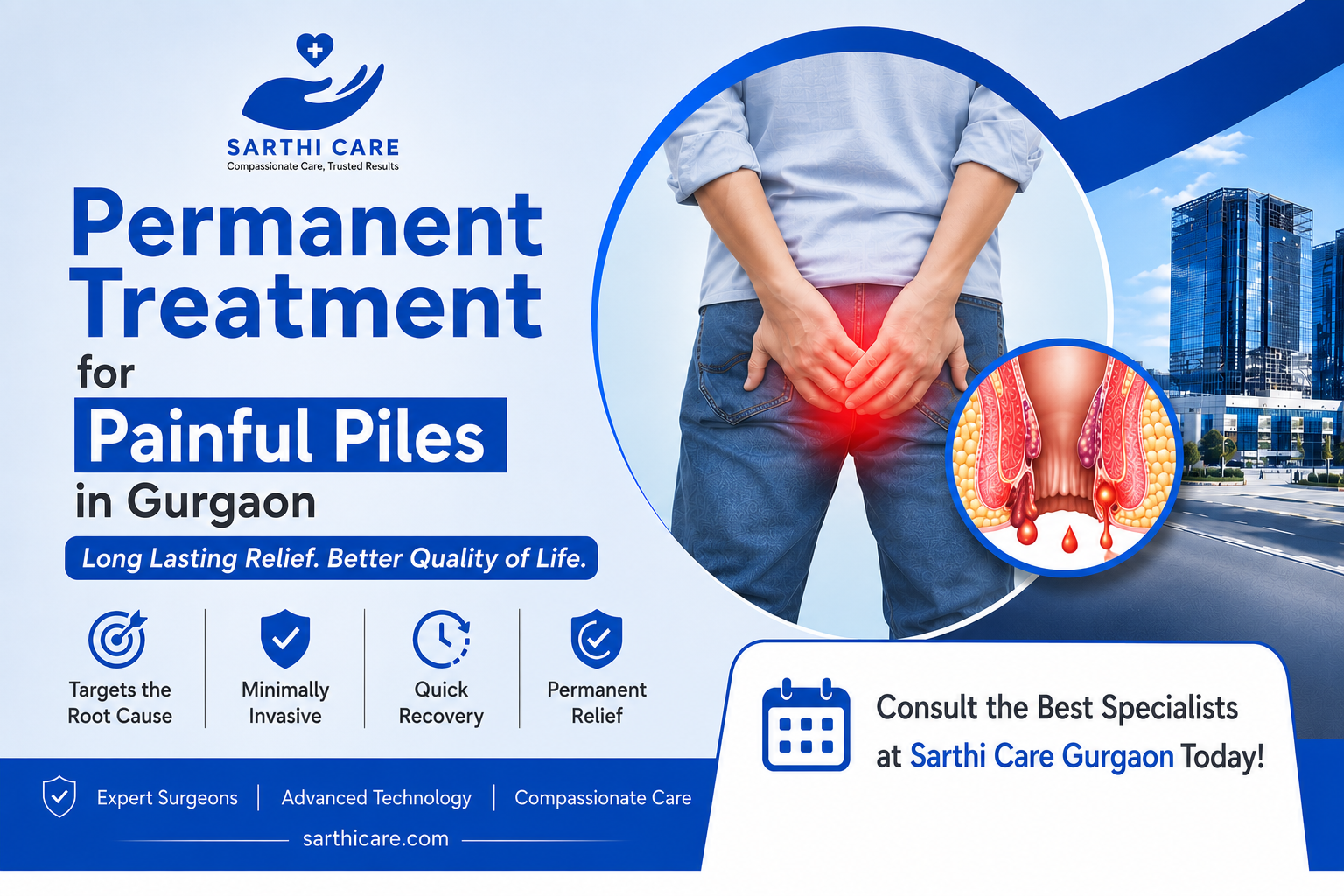
Painful piles can make sitting, walking, working, and passing stool difficult. Some patients experience a constant ache, while others develop sudden severe pain with swelling or a tender lump near the anus.
People searching for permanent treatment for painful piles in Gurgaon usually want more than temporary relief from creams or pain medicines. They want the underlying problem treated so that pain, swelling, bleeding, and prolapse do not keep returning.
Modern procedures—including laser treatment, hemorrhoidal artery ligation, and hemorrhoidectomy—can provide long-lasting relief in appropriately selected patients. However, no responsible doctor should guarantee that piles will never return. The correct treatment depends on whether the piles are internal, external, prolapsed, or thrombosed, as well as their grade and the patient’s bowel habits.
Sarthi Care provides evaluation and coordinates minimally invasive and surgical treatment for piles in Gurgaon.
Why Do Piles Become Painful?
Piles, also known as hemorrhoids, are swollen blood vessels and supporting tissues inside or around the anus.
Internal piles develop inside the rectum. They commonly cause bright-red bleeding or prolapse but are often not painful unless they become significantly prolapsed, swollen, or trapped outside the anus.
External piles develop beneath the skin surrounding the anus. They can cause soreness, irritation, and pain, particularly while sitting.
A thrombosed external pile occurs when a blood clot develops inside an external hemorrhoid. It may produce sudden, severe pain and a firm blue, purple, or dark lump near the anus.
Pain may also be caused by:
- A prolapsed internal pile that has become swollen
- A strangulated haemorrhoid with reduced blood flow
- Repeated irritation after bowel movements
- Constipation and hard stool
- Infection or an associated abscess
- An anal fissure occurring alongside piles
Severe anal pain should not automatically be assumed to be piles. Anal fissures, fistulas, abscesses, and other anorectal conditions can cause similar symptoms. An examination is necessary before selecting treatment.
Is Permanent Treatment for Painful Piles Possible?
Treatment can remove or shrink existing piles and provide long-term symptom control. What it cannot do is guarantee that new hemorrhoids will never develop.
The NHS specifically states that treatment does not always prevent piles from returning. Recurrence risk is influenced by constipation, excessive straining, prolonged toilet sitting, heavy lifting, pregnancy, body weight, and the original severity of the disease.
A realistic definition of permanent treatment is the following:
- Treating the current haemorrhoidal tissue effectively
- Controlling pain, bleeding and prolapse
- Selecting a procedure appropriate for the pile type and grade
- Correcting constipation and unhealthy toilet habits
- Following postoperative and long-term preventive advice
Claims such as “100% permanent cure,” “zero recurrence,” and “guaranteed lifetime relief” are medically unreliable.
First Step: Confirm the Cause of Pain
Proper diagnosis matters because different causes of anal pain require different treatments.
During consultation, the doctor may ask about the following:
- Duration and severity of pain
- Whether pain began suddenly
- Bleeding during or after passing stool
- Presence of a lump or swelling
- Prolapse during bowel movements
- Constipation or diarrhoea
- Previous piles treatment
- Current medicines and health conditions
The examination may include:
- Inspection of the anal area
- Digital rectal examination
- Anoscopy
- Proctoscopy
Further investigation may be advised if bleeding is persistent, symptoms are unusual or another bowel condition is suspected.
Seek prompt medical care when anal pain is severe, bleeding is heavy or continuous, large blood clots are present, or pain occurs with fever, abdominal discomfort, or diarrhea.
Treatment Options for Painful Piles
Treatment should be based on the diagnosis rather than automatically choosing laser surgery.
Medicines and lifestyle treatment
Mild piles may improve with:
- Increased dietary fibre
- Adequate water intake
- Stool-softening medicines when prescribed
- Warm sitz baths
- Short-term pain medicines
- Avoiding straining
- Reducing time spent on the toilet
Creams and suppositories may temporarily reduce mild pain, itching, or swelling. They do not permanently remove larger, prolapsed, or thrombosed piles.
NIDDK recommends medical review when over-the-counter treatment does not improve symptoms after approximately one week.
Treatment for thrombosed external piles
A recently thrombosed external pile may cause intense pain. Some cases gradually improve with pain control, stool softeners, dietary measures, and sitz baths.
Selected patients may benefit from early surgical excision, particularly when pain is severe. The 2024 American Society of Colon and Rectal Surgeons guideline notes that early excision may provide faster symptom resolution in selected patients with thrombosed external hemorrhoids.
Laser treatment is not automatically the standard treatment for every thrombosed external pile. The doctor must first assess how long the clot has been present and how severe the symptoms are.
Rubber-band ligation
Banding is commonly used for suitable bleeding or prolapsing internal piles.
A small band is placed around the base of the hemorrhoid, cutting off its blood supply. The treated tissue shrinks and usually separates after several days.
Banding does not treat large external piles and may not be sufficient for extensive Grade 3 or Grade 4 prolapse.
Sclerotherapy and coagulation procedures
Sclerotherapy involves injecting a solution into an internal hemorrhoid to make it shrink. Infrared coagulation and electrocoagulation similarly reduce the blood supply to selected internal piles.
These treatments are generally more appropriate for early-stage internal hemorrhoids than for large, painful external disease.
Laser Treatment for Painful Piles
Laser pile treatment uses controlled energy to shrink or remove hemorrhoidal tissue. Depending on the technique, a laser fiber may be introduced into an internal pile to coagulate its blood supply and reduce its size.
Potential benefits in selected cases may include:
- No large external incision with some techniques
- Limited blood loss
- Less tissue disruption
- Daycare treatment in medically suitable patients
- Earlier return to light routine activities
- Less postoperative discomfort than some conventional operations
Laser treatment is not completely painless. Anesthesia controls pain during the operation, but discomfort, pressure, bleeding, or swelling may occur after treatment.
It is also not appropriate for every painful pile. Patients with a large external component, extensive grade 4 prolapse, strangulated piles, or a painful thrombosed external hemorrhoid may require another procedure.
Sarthi Care’s existing Gurgaon page states that it coordinates laser treatment as a daycare procedure and offers cashless-insurance assistance through partner hospitals. Same-day discharge and recovery time should nevertheless be decided according to the patient’s medical condition and response to anesthesia.
When Is Hemorrhoidectomy Recommended?
Hemorrhoidectomy involves surgically removing the affected hemorrhoidal tissue. It may be recommended for:
- Large external piles
- Combined internal and external piles
- Symptomatic Grade 3 or Grade 4 haemorrhoids
- Repeated prolapse
- Persistent symptoms after office procedures
- Cases unsuitable for less invasive treatment
The 2024 ASCRS guideline recommends considering excisional hemorrhoidectomy for selected patients with external hemorrhoids or symptomatic combined internal and external Grade 3–4 disease.
Hemorrhoidectomy may involve more postoperative discomfort and wound care than some minimally invasive procedures. However, it can be a more appropriate and definitive treatment for extensive disease.
Selecting a less invasive procedure simply because it sounds easier can produce poor results when the anatomy requires surgical removal.
What Happens During the Treatment Process?
The treatment pathway commonly includes:
- Specialist consultation and examination
- Identification of the pile type and grade
- Review of previous treatment and health history
- Preoperative investigations when required
- Discussion of laser and non-laser alternatives
- Anaesthesia assessment
- Daycare or hospital treatment
- Post-treatment observation
- Discharge instructions and follow-up
Patients should tell the medical team about blood-thinning medicines, diabetes, hypertension, allergies, and previous reactions to anesthesia.
Blood-thinning medicines must not be stopped without instructions from the prescribing doctor or treating surgeon.
Recovery After Painful Piles Treatment
Recovery depends on the procedure performed. An office-based procedure usually requires less downtime than a hemorrhoidectomy.
After treatment, patients may be advised to:
- Take prescribed pain medications correctly
- Use a stool softener when recommended
- Drink sufficient fluids
- Eat fibre-rich foods
- Avoid straining
- Take warm sitz baths
- Keep the area clean and dry
- Begin gentle walking
- Avoid heavy lifting temporarily
- Attend the scheduled follow-up
Some bleeding after surgery can occur. Heavy bleeding, worsening pain, fever, inability to pass urine, or increasing swelling requires prompt medical assessment.
Same-day discharge does not mean complete same-day recovery. Patients should arrange for a responsible adult to take them home after anesthesia.
How to Reduce the Risk of Piles Returning
Long-term relief requires more than removing the present hemorrhoids.
Patients should:
- Consume vegetables, fruits, whole grains and other high-fibre foods
- Drink adequate water
- Treat recurring constipation
- Avoid delaying bowel movements
- Avoid forceful straining
- Limit unnecessary toilet sitting
- Exercise regularly
- Maintain a healthy body weight
- Use correct lifting techniques
- Follow the surgeon’s postoperative advice
Fiber, adequate fluids, and healthier toilet habits help prevent hard stools and reduce pressure on the hemorrhoidal tissues.
Why Consult Sarthi Care in Gurgaon?
Sarthi Care coordinates treatment for bleeding, prolapsing, and painful piles in Gurgaon.
The care pathway may include:
- Specialist examination
- Pile grading
- Evaluation of internal, external or thrombosed piles
- Laser-treatment suitability assessment
- Conventional surgery when clinically necessary
- Daycare-treatment coordination
- Cost-estimate guidance
- Cashless-insurance assistance
- Post-treatment follow-up support
The final procedure should be selected after examination. Laser should not be promised before confirming whether the pain is caused by internal piles, an external thrombosis, an anal fissure, or another condition.
Frequently Asked Questions
Can painful piles be cured permanently?
Existing piles can be treated successfully, but no procedure guarantees that piles will never return. Long-term results also depend on controlling constipation and avoiding straining.
Is laser the best permanent treatment for piles?
Not for every patient. Laser may suit selected internal hemorrhoids. Large external piles, advanced combined disease, or thrombosed piles may require another treatment.
Why are my piles suddenly extremely painful?
Sudden severe pain with a firm lump can occur with a thrombosed external pile. Severe pain may also indicate another condition, so prompt examination is recommended.
Is pile surgery painless?
No operation should be advertised as completely painless. Anesthesia prevents pain during surgery, while postoperative discomfort is managed with medicines and supportive care.
Can I go home on the same day?
Many office and minimally invasive procedures are managed as daycare treatment. Some patients require extended observation or discharge on the following day.
Will creams permanently remove painful piles?
Creams may temporarily reduce irritation and mild pain. They do not permanently remove large, prolapsed, or thrombosed hemorrhoids.
Book a Consultation for Painful Piles in Gurgaon
Repeated pain, swelling, or bleeding should not be managed indefinitely with over-the-counter creams.
To discuss permanent treatment for painful piles in Gurgaon, schedule an evaluation with Sarthi Care. A specialist can confirm the cause of pain, determine the pile type and grade, and explain the most appropriate treatment for lasting symptom relief.
Medical disclaimer: This page provides general educational information and does not replace an examination, diagnosis, or treatment by a qualified medical professional.