
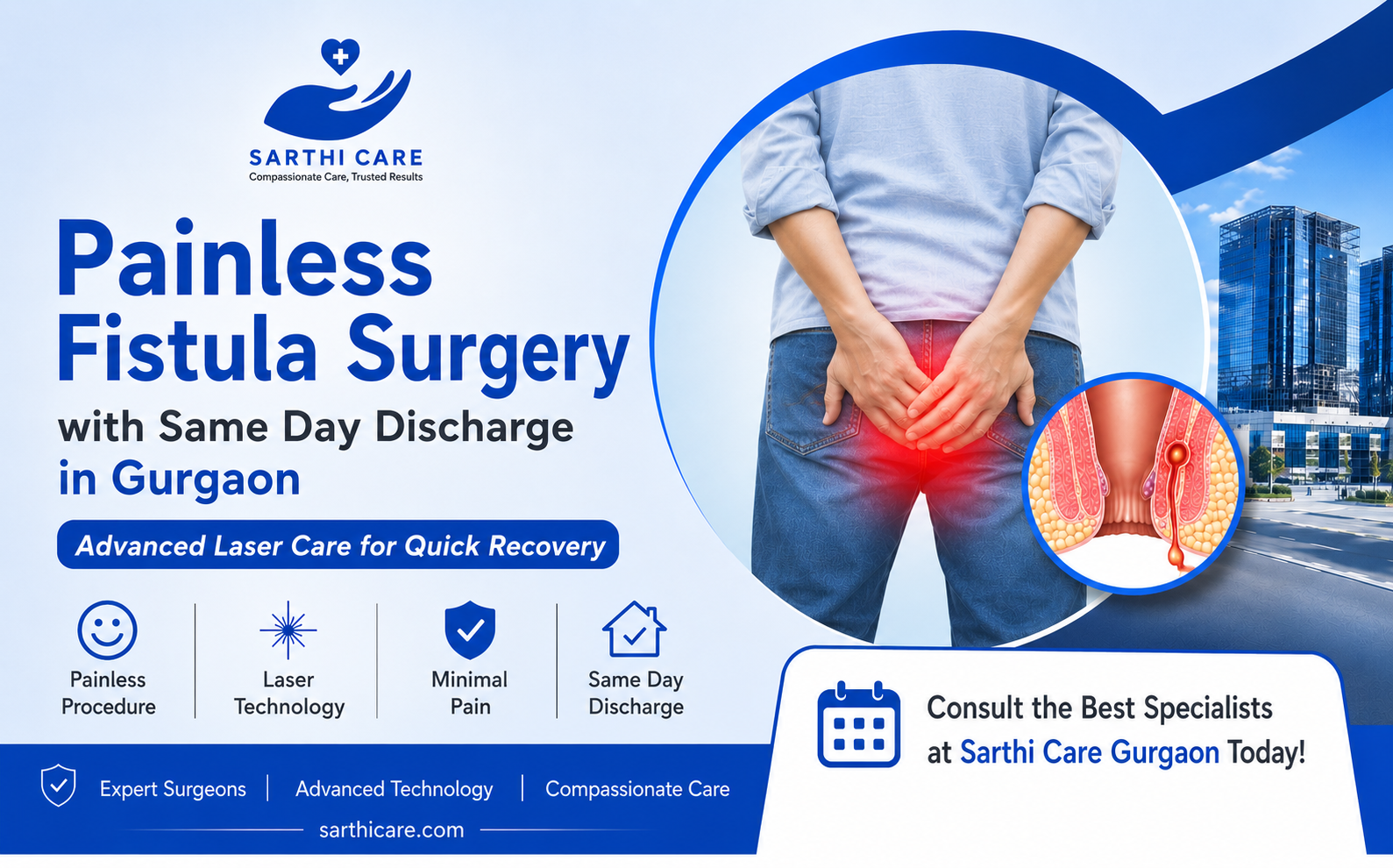
Patients searching for painless fistula surgery with same-day discharge in Gurgaon are usually concerned about postoperative pain, a long hospital stay, large wounds, and extended time away from work.
Minimally invasive techniques such as laser fistula closure may reduce surgical trauma and allow suitable patients to leave the hospital on the day of treatment. However, no responsible doctor should guarantee that fistula surgery will be completely painless or that every patient will be discharged on the same day.
Anesthesia prevents pain during the operation, but some discomfort, bleeding, swelling, or discharge can occur afterward. Same-day discharge is possible only when the patient has recovered adequately from anesthesia, has stable vital signs, and does not have a complication requiring continued observation. Oxford University Hospitals describes laser fistula ablation as a minimally invasive procedure that is commonly managed with same-day discharge, while also warning that pain, bleeding, infection, and recurrence can occur.
Sarthi Care provides consultation and coordinates minimally invasive fistula treatment options in Gurgaon according to the type and complexity of the fistula.
What Is an Anal Fistula?
An anal fistula is an abnormal tunnel connecting the anal canal to the skin near the anus. It commonly develops after an anal abscess or infected gland fails to heal fully.
Typical symptoms include the following:
- Repeated pain or swelling near the anus
- Pus or blood-stained discharge
- A small opening or boil near the anus
- Skin irritation and itching
- Pain while sitting or passing stool
- Recurrent anal abscesses
- Fever during an active infection
Anal fistulas usually do not heal permanently without treatment, and surgery is often required. The procedure is selected according to the tract’s position, whether it has branches, and how much anal sphincter muscle it crosses.
The sphincter muscles help control bowel movements. Therefore, fistula surgery must achieve two objectives: close the infected tract and avoid unnecessary damage to those muscles.
Is Fistula Surgery Really Painless?
The accurate answer is no—not completely.
The procedure itself is performed under regional or general anesthesia, so the patient should not experience surgical pain while it is being carried out. After the anesthesia wears off, mild or moderate discomfort may occur.
Laser treatment may involve a smaller external wound than traditional fistulotomy in selected cases. This can mean less wound care and potentially less postoperative discomfort. It does not mean zero pain.
Patients may experience:
- Tenderness around the treated area
- Mild bleeding or fluid discharge
- Discomfort during the first bowel movements
- Temporary swelling
- A need for pain-relief medicines
- Irritation requiring a small absorbent pad
Oxford University Hospitals specifically advises that minor bleeding and pain may occur after laser treatment and that discomfort can occur while passing stool.
For medically responsible marketing, use phrases such as “low-discomfort,” “pain managed with anesthesia and prescribed medicines,” or “may cause less postoperative discomfort in suitable cases.”
What Is Laser Fistula Surgery?
Laser fistula treatment is also known as fistula-tract laser closure or FiLaC. It is a sphincter-preserving procedure designed to treat the tract internally rather than cutting open its entire length.
During the procedure:
- The surgeon identifies the internal and external fistula openings.
- The tract is examined and cleaned.
- A thin laser fiber is inserted through the external opening.
- Laser energy is delivered while the fiber is slowly withdrawn.
- The energy destroys the tract lining and causes the tunnel to shrink.
- The internal opening may also be closed with stitches or another technique.
The laser component often takes approximately 30 minutes, although the total theater and hospital time is longer because of preparation, anesthesia, and postoperative observation. The procedure tends to work best when the tract is relatively simple and narrow.
Laser is not automatically the best procedure for every fistula. Complex, recurrent, or branching fistulas may require MRI mapping, seton drainage, LIFT, VAAFT, an advancement flap, or combined treatment.
Can Patients Go Home on the Same Day?
Many suitable anal fistula operations do not require an overnight hospital stay. The NHS states that fistula surgery is generally performed under general anesthesia and, in many cases, overnight admission is unnecessary.
Before discharge, the medical team generally checks whether the patient:
- Has recovered sufficiently from anaesthesia
- Has stable blood pressure and pulse
- Can drink fluids without persistent vomiting
- Can walk safely
- Has controlled pain
- Has no concerning bleeding
- Can pass urine
- Has a responsible adult available to take them home
Same-day discharge is a hospital-management decision, not a guaranteed feature of the laser machine.
The patient should arrange transportation and should not drive home after receiving anesthesia or sedative medicines.
Who May Be Suitable for Daycare Laser Surgery?
A patient may be considered for same-day minimally invasive treatment when:
- The fistula tract is suitable for laser closure
- There is no uncontrolled active infection
- No extensive abscess requires prolonged treatment
- The patient is medically fit for anaesthesia
- Pain and bleeding remain controlled after surgery
- Adequate support is available at home
- The patient can return quickly if a complication occurs
The fistula’s anatomy is more important than the patient’s preference for a specific technology.
Laser and endoscopic procedures have shown reasonable short-term healing results, but the American Society of Colon and Rectal Surgeons states that long-term healing and recurrence outcomes remain uncertain. Its recommendation is based on low-quality evidence.
NICE similarly states that evidence concerning laser fistula treatment is limited in quality and quantity. It recommends clear consent regarding uncertainty and says the procedure should be performed by clinicians experienced in fistula cannulation and trained in laser use.
Who May Need Overnight Observation or Staged Treatment?
Same-day discharge may not be appropriate when the patient has:
- A large or deep abscess
- A complex or horseshoe fistula
- Multiple fistula branches
- Significant sphincter involvement
- Persistent vomiting after anaesthesia
- Uncontrolled pain or bleeding
- Difficulty passing urine
- Uncontrolled diabetes or blood pressure
- A bleeding disorder
- Significant heart or respiratory disease
- No responsible adult available at home
Complex fistulas may require a draining seton before definitive treatment. A seton keeps the tract open so infection can drain, but a loose seton usually controls the condition rather than curing it. Further procedures may be required.
Describing staged treatment as a failure would be wrong. In some complex cases, separating infection control and fistula closure is the safer approach.
Recovery After Same-Day Fistula Surgery
Same-day discharge does not mean same-day recovery.
Most patients need at least a few days away from work, depending on the fistula size, procedure, and physical demands of their job. Return to normal activities varies between patients.
After discharge, patients may be advised to:
- Take prescribed pain medications as directed
- Use stool softeners or laxatives when prescribed
- Drink sufficient water
- Eat fibre-rich food
- Avoid straining during bowel movements
- Clean the area after passing stool
- Use a warm sitz bath when recommended
- Wear a small pad for temporary discharge
- Begin gentle walking
- Avoid heavy lifting and strenuous exercise
- Attend every follow-up appointment
The internal fistula tract needs time to close even when there is no large external wound. A quick return to basic activities should not be confused with complete healing.
Risks and Limitations of Laser Fistula Surgery
Potential risks include the following:
- Pain
- Bleeding
- Infection
- Persistent discharge
- Failure of the tract to close
- Recurrent fistula
- Need for another operation
- Continence problems, depending on fistula anatomy and treatment
Recurrence can occur months or years after laser treatment, particularly when the original fistula is large or complex.
The NHS lists infection, recurrence, and possible bowel-control problems among the recognized risks of anal fistula treatment. The level of risk depends on the fistula location and the operation selected.
Avoid claims such as “100% success,” “permanent cure,” “no recurrence,” and “zero pain.” They are not supported by current guidance.
Why Choose Sarthi Care in Gurgaon?
Sarthi Care’s Gurgaon service page lists laser treatment and minimally invasive fistula care, along with daycare coordination and insurance assistance.
A responsible treatment pathway should include the following:
- Consultation with an experienced surgeon
- Examination and fistula classification
- MRI fistulogram when clinically required
- Assessment of sphincter involvement
- Discussion of laser and non-laser options
- Anaesthesia assessment
- Individual discharge planning
- Clear postoperative instructions
- Follow-up until adequate healing
The treatment should not be labeled “laser surgery” before the fistula has been examined. Some patients will obtain a better result from fistulotomy, LIFT, seton treatment, VAAFT, or a combined procedure.
Frequently Asked Questions
Is laser fistula surgery completely painless?
No. Anesthesia controls pain during the operation, but discomfort, tenderness, or pain can occur after treatment. Pain is generally managed with prescribed medicines and postoperative care.
Is same-day discharge guaranteed?
No. Many suitable patients can leave on the day of surgery, but overnight observation may be required if recovery from anesthesia is delayed or complications occur.
Can I return to work the next day?
That should not be promised. Most patients need a few days away from work, and those with physically demanding jobs may need longer.
Is laser suitable for a complex fistula?
It may be used in selected complex cases, often with another procedure. MRI mapping, seton drainage, or staged surgery may be necessary.
Can the fistula return after laser treatment?
Yes. Recurrence is possible after laser and other fistula operations. Current guidelines note uncertainty about long-term healing and recurrence outcomes following minimally invasive laser closure.
Will there be an open wound?
Laser closure usually avoids opening the entire tract, but a small external wound, drainage opening, or additional incision may still be present. The exact result depends on the procedure performed.
Book a Fistula Consultation in Gurgaon
Patients searching for painless fistula surgery with same-day discharge in Gurgaon should first determine whether they are suitable for minimally invasive daycare treatment.
Book a consultation with Sarthi Care for fistula assessment, treatment planning, expected pain-management guidance, and individual discharge advice. The surgeon can explain whether laser closure, LIFT, VAAFT, a seton, or another procedure is appropriate.
Medical disclaimer: This information is for general education and does not replace examination, diagnosis, or treatment by a qualified medical professional.
Before publishing, replace the existing website statement “painless intervention and same-day discharge” with “minimally invasive treatment with pain-management support and possible same-day discharge for medically suitable patients.”