
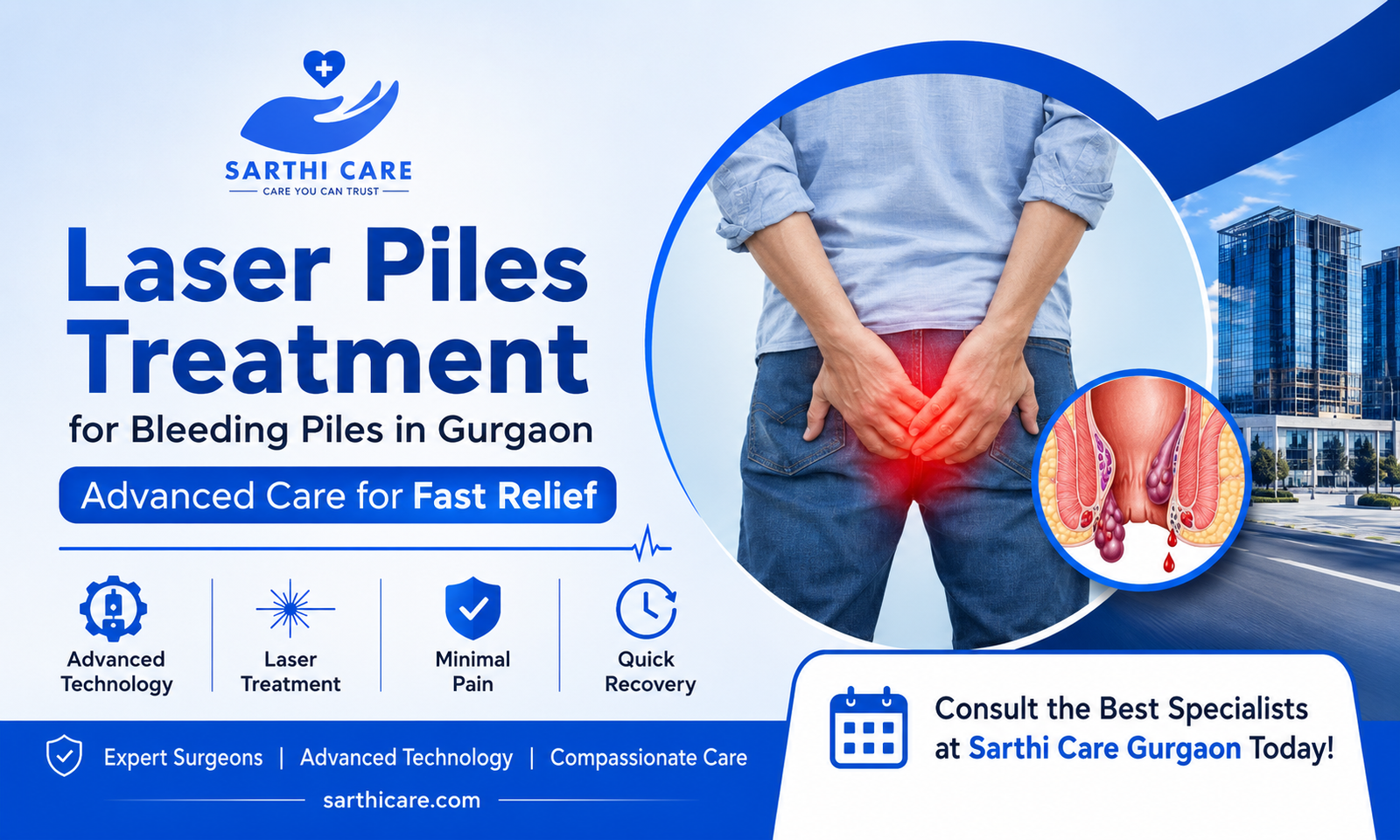
Bleeding while passing stool can be alarming, uncomfortable, and easy to ignore because of embarrassment. Although bright-red blood may occur with piles, rectal bleeding should not automatically be assumed to be hemorrhoids. A medical examination is important to confirm the cause and rule out other anal or bowel conditions.
For people searching for laser pile treatment for bleeding piles in Gurgaon, Sarthi Care provides access to specialist consultation, minimally invasive treatment planning, hospital coordination, and post-treatment support. The correct treatment depends on the type and grade of piles, the amount of bleeding, associated symptoms, and the patient’s overall health.
What Are Bleeding Piles?
Piles, also known as hemorrhoids, are swollen blood vessels in or around the anus and lower rectum. Internal piles develop inside the rectum, while external piles form around the anus. Internal piles are more commonly associated with painless, bright-red bleeding during or after bowel movements.
Other possible symptoms include:
- Itching or irritation around the anus
- Pain or discomfort while passing stool
- Swelling or a lump near the anus
- Mucus discharge
- A feeling of incomplete bowel evacuation
- Discomfort while sitting
- Prolapse, where the pile comes outside the anus
Common contributing factors include chronic constipation, straining during bowel movements, prolonged toilet sitting, pregnancy, obesity, heavy lifting, and a low-fiber diet. Mild symptoms may improve with fiber, adequate fluids, stool-softening measures, and healthier toilet habits. Persistent bleeding, prolapse, or repeated flare-ups may require a medical procedure. Don’t Ignore Rectal Bleeding
Bleeding piles are common, but not every case of rectal bleeding is caused by piles. Medical assessment is recommended when bleeding continues, returns frequently, or occurs with the following:
- A change in bowel habits
- Abdominal pain or discomfort
- Unexplained weight loss
- Fever
- Dizziness or weakness
- Dark or black stools
- Increasing anal pain
Urgent care may be required if the bleeding does not stop, there is a large amount of blood, blood clots are present, or the pain is severe. Assessment is particularly important for older adults, people taking blood-thinning medicines, and anyone with a personal or family history of bowel disease. Is Laser Treatment for Bleeding Piles?
Laser pile treatment is a minimally invasive procedure in which controlled laser energy is applied to hemorrhoidal tissue. Depending on the technique used, the laser shrinks or removes the affected tissue while limiting damage to nearby healthy tissue.
In laser hemorrhoid ablation, a thin laser fiber is inserted into the hemorrhoid. Laser energy is then delivered to the swollen tissue, causing it to shrink. The procedure is generally performed under anesthesia and often takes approximately 20 to 30 minutes. The actual duration depends on the number, size, location, and grade of the hemorrhoids. Treatment is not automatically the best option for every patient. Early-stage piles may respond to medicines, dietary changes, or office-based procedures such as rubber-band ligation. Large external piles, extensive prolapse, or another anorectal condition may require a different procedure.
The treatment method should be selected after examination rather than choosing surgery only because it is advertised as “laser treatment.”
Who May Be Suitable for Laser Pile Treatment?
A piles specialist may consider laser surgery for patients experiencing the following:
- Recurrent bleeding despite medicines and lifestyle changes
- Internal piles that prolapse during bowel movements
- Suitable Grade II or Grade III haemorrhoids
- Persistent irritation, discomfort or mucus discharge
- Symptoms affecting work or routine activities
- Haemorrhoids that have not responded to conservative treatment
Suitability depends on clinical findings. Pregnancy, active infection, uncontrolled medical conditions, blood-thinning medicines, and other anorectal diseases can affect the recommended treatment plan.
Patients should tell their doctor about their complete medical history, allergies, previous operations, and all medicines or supplements they currently take.
How Are Bleeding Piles Diagnosed?
Diagnosis begins with a detailed discussion about the patient’s symptoms, bleeding pattern, bowel habits, diet, medicines, and previous treatments.
The doctor may perform the following:
- An external examination
- A digital rectal examination
- Anoscopy
- Proctoscopy
Further investigation may be advised when the diagnosis is uncertain, the bleeding pattern is unusual or the patient has risk factors for another bowel condition.
Treating presumed piles without confirming the actual source of bleeding can delay the correct diagnosis. Therefore, proper examination is an essential part of bleeding piles treatment in Gurgaon.
Potential Benefits of Laser Piles Surgery
For appropriately selected patients, laser pile treatment may provide the following advantages:
- No large external incision in certain techniques
- Less tissue damage than conventional excisional surgery
- Less postoperative pain in some patients
- Limited blood loss during the procedure
- Same-day discharge in uncomplicated cases
- Faster return to routine activities
- Simpler wound care when no large open wound is created
These are potential benefits and not guaranteed outcomes. Recovery depends on the grade of piles, the procedure performed, the patient’s health, bowel habits, and adherence to aftercare instructions.
Terms such as “completely painless,” “zero recurrence,” and “guaranteed cure” should be avoided. Every surgical procedure has possible risks, and individual results vary.
What Happens During Laser Pile Treatment?
Before the procedure, the medical team reviews the patient’s history, test reports, allergies, and current medicines. The patient receives instructions regarding fasting, medicines, and arrival at the hospital.
Anesthesia may be local, spinal, or general, depending on the planned procedure and the patient’s condition.
During treatment, the surgeon identifies the affected hemorrhoidal tissue and delivers laser energy through a fine fiber. The treated tissue gradually shrinks.
When external piles, skin tags, thrombosis, anal fissures, or another anorectal condition is also present, an additional or alternative procedure may be necessary.
After treatment, the patient is observed until the effects of anesthesia have reduced and vital signs are stable. Many patients can return home on the same day. An attendant should accompany the patient, and driving restrictions provided by the medical team must be followed. ery After Laser Piles Treatment
Mild pain, pressure, discharge, or a small amount of bleeding may occur during recovery. Patients are generally advised to:
- Take prescribed medicines as directed
- Keep stools soft
- Drink adequate water
- Eat fibre-rich foods
- Avoid straining during bowel movements
- Maintain proper anal hygiene
- Take warm sitz baths when advised
Walking is usually encouraged. Heavy lifting, strenuous exercise, and prolonged sitting may need to be restricted temporarily.
Many people with desk-based jobs can return to work within a few days, but recovery time is different for every patient. People with larger piles, multiple treated areas, or physically demanding jobs may require additional recovery time.
Contact the treating team if there is heavy or persistent bleeding, increasing pain, fever, difficulty passing urine, inability to pass stool, or worsening swelling. Patients should attend the scheduled follow-up even when their symptoms have improved.
Possible Risks and Limitations
No pile procedure is completely painless or risk-free. Potential complications can include:
- Postoperative pain
- Bleeding
- Difficulty passing urine
- Infection
- Temporary discharge
- Thrombosis
- Recurrence
- Need for additional treatment
Some bleeding may occur after hemorrhoid treatment. Piles can also return when constipation, straining, prolonged toilet sitting, and other contributing habits continue. Proceeding, patients should ask which laser technique is being proposed, why it is suitable, what alternatives are available, which type of anesthesia will be used, and what recovery can realistically be expected.
Why Choose Sarthi Care in Gurgaon?
Sarthi Care coordinates consultation and treatment for proctology conditions such as piles, anal fissure, and anal fistula.
For patients seeking laser pile treatment for bleeding piles in Gurgaon, Sarthi Care’s stated services include the following:
- Access to specialist evaluation
- Personalised treatment planning
- Coordination with partner hospitals
- Assistance with hospital admission and discharge
- Cashless insurance-support assistance
- Dedicated care coordination
- Post-treatment guidance
Patients can discuss available procedures, expected treatment costs, and insurance eligibility before making a decision. The final recommendation is provided after clinical assessment because the same procedure is not appropriate for every type or grade of hemorrhoid. o Reduce the Risk of Piles Returning
Surgery treats existing hemorrhoids, but long-term control also requires healthier bowel habits.
Patients should:
- Eat vegetables, fruits, whole grains and other fibre-rich foods
- Drink sufficient water
- Remain physically active
- Avoid delaying the urge to pass stool
- Avoid straining
- Limit unnecessary time on the toilet
- Treat constipation under medical guidance
- Take movement breaks during long working hours
People who regularly lift heavy weights should use proper lifting techniques and avoid repeatedly holding their breath or straining.
Frequently Asked Questions
Is laser treatment suitable for every case of bleeding piles?
No. Suitability depends on whether the piles are internal or external, their grade, the degree of prolapse, previous treatments, and the patient’s overall health.
Is laser pile treatment completely painless?
Anesthesia helps control pain during the procedure. Laser techniques may cause less postoperative pain than some conventional operations, but mild or moderate discomfort can still occur.
Can a patient go home on the same day?
Many laser pile procedures are performed as daycare treatments. Same-day discharge depends on recovery from anesthesia, the type of procedure, and the surgeon’s assessment.
How soon can I return to work?
People with desk-based work may return within a few days. Patients with physically demanding jobs may need a longer recovery period.
Will bleeding stop immediately after treatment?
Bleeding caused by the hemorrhoids should improve after successful treatment. However, a small amount of postoperative bleeding can occur. Heavy, persistent, or increasing bleeding requires medical review.
What is the cost of laser pile treatment in Gurgaon?
The cost depends on the hospital, investigations, anesthesia, grade of piles, selected procedure, medicines, and insurance coverage. A written estimate should be obtained after consultation and examination.
Book a Consultation for Bleeding Piles in Gurgaon
Persistent rectal bleeding deserves a proper diagnosis, not guesswork. To discuss laser pile treatment for bleeding piles in Gurgaon, book a consultation with Sarthi Care.
A specialist can identify the cause of bleeding, determine the grade and type of hemorrhoids, explain suitable treatment alternatives, and provide an individual recovery plan.
Medical disclaimer: This content is provided for patient education and does not replace an examination, diagnosis, or treatment by a qualified medical professional.