
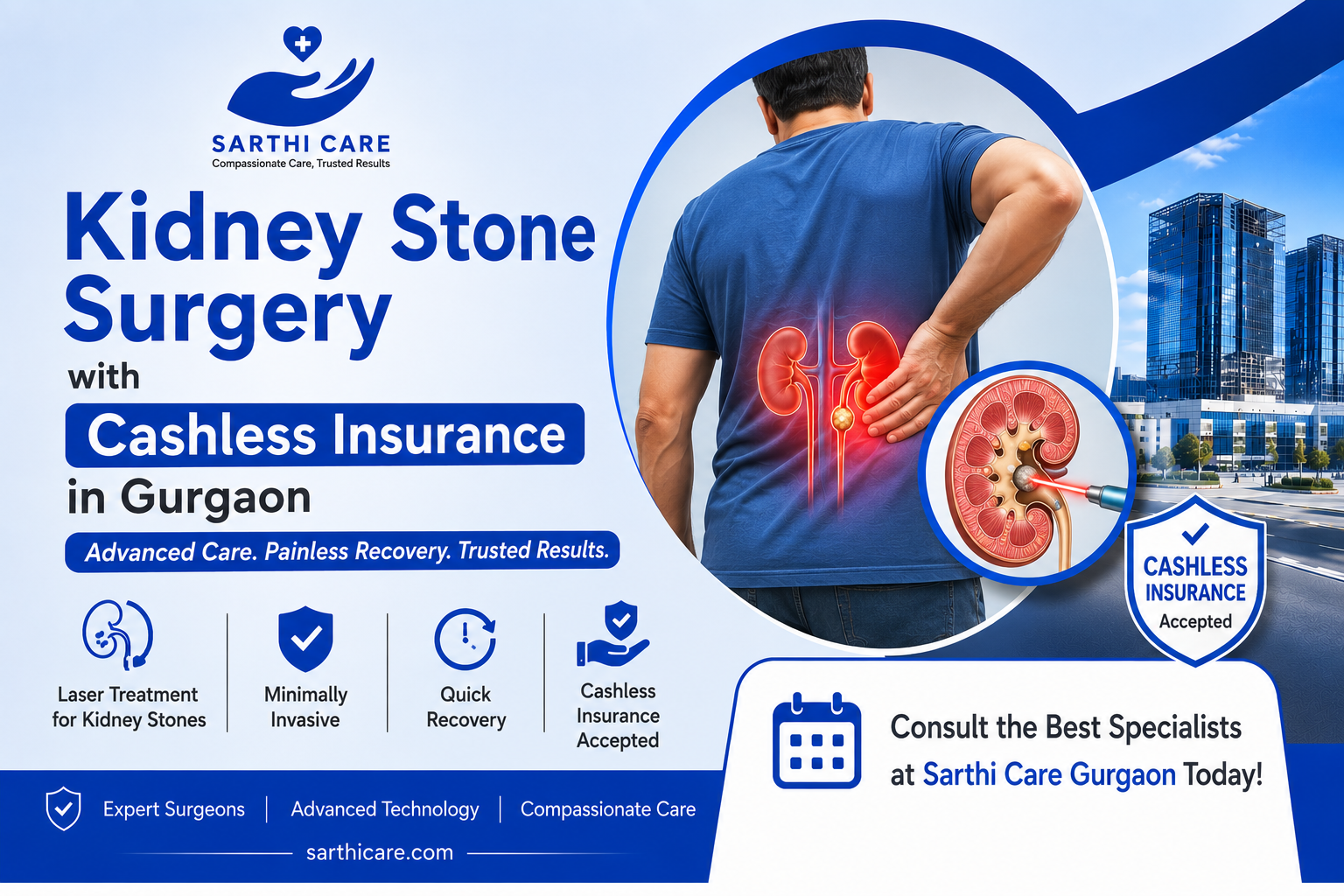
Kidney stones can cause severe pain, blood in the urine, nausea, difficulty urinating, and repeated urinary infections. Small stones may pass naturally, but larger or obstructing stones can require a procedure such as ureteroscopy, laser lithotripsy, RIRS, shockwave lithotripsy, or PCNL.
For eligible policyholders, kidney stone surgery with cashless insurance in Gurgaon may be available through an insurer-approved hospital or another hospital accepted under the insurer’s cashless process. Under a cashless claim, the insurer settles the authorized portion of the hospital bill directly with the hospital.
Cashless treatment does not automatically mean completely free treatment. Patients may still need to pay deductibles, co-payments, non-medical expenses, excluded consumables, upgraded-room charges, or any amount above the insurer’s approved package.
Sarthi Care states that it provides cashless insurance assistance at partner hospitals in Gurgaon. The team may help coordinate consultation, hospital admission, and pre-authorization, but only the insurer or third-party administrator can approve the claim.
When Is Kidney Stone Surgery Required?
Not every kidney stone needs surgery. Treatment depends on several factors:
- Stone size
- Location in the kidney or ureter
- Severity and duration of pain
- Urinary obstruction
- Kidney swelling
- Presence of infection
- Kidney function
- Number and hardness of stones
- Previous failed treatment
- Whether the patient has one functioning kidney
Some small ureteric stones may pass with pain management, fluids, and medicines prescribed by a urologist. Surgery may be recommended when a stone is unlikely to pass, pain remains uncontrolled, urine flow is obstructed, infection is present or kidney function is at risk.
NICE guidance recommends offering surgical treatment to adults with ureteric stones and renal colic when the pain remains intolerable or the stone is unlikely to pass. Urgent assessment is particularly important when fever, a solitary kidney, or uncertainty about the diagnosis is present.
Kidney Stone Surgery Options in Gurgaon
“Kidney stone surgery” is not one specific operation. The urologist selects the procedure according to the stone’s size, position, density, and surrounding anatomy.
Ureteroscopy and laser lithotripsy
Ureteroscopy, commonly abbreviated as URS, is often used for stones located in the ureter.
A thin endoscope is passed through the urethra and bladder into the ureter. The stone may be removed with a small basket or broken into fragments using laser energy. No external skin incision is normally required.
A temporary DJ stent may be inserted to maintain urine drainage after the procedure. The stent can cause urinary frequency, discomfort, or blood in the urine until it is removed.
Retrograde intrarenal surgery
Retrograde intrarenal surgery, or RIRS, is used to treat selected stones inside the kidney.
A flexible ureteroscope is passed through the natural urinary passage into the kidney. Laser energy breaks the stone into smaller fragments, which may be removed or allowed to pass gradually.
RIRS may be considered for stones unsuitable for shockwave treatment or when the urologist wants direct visual access to the stone.
Percutaneous nephrolithotomy
Percutaneous nephrolithotomy, known as PCNL, is generally used for large or complex kidney stones.
The surgeon makes a small opening in the patient’s back and creates a tract directly into the kidney. A nephroscope is passed through this tract to fragment and remove the stone.
NICE recommends PCNL for renal stones larger than 20 mm, including staghorn stones, while ureteroscopy may be considered when PCNL is not appropriate. The final decision depends on clinical findings rather than stone size alone.
Shockwave lithotripsy
Shockwave lithotripsy, also called SWL or ESWL, uses externally generated shockwaves to break a stone into fragments that can pass through the urine.
It does not require an instrument to enter the kidney, but it may not work equally well for every stone. Stone size, density, location, and the patient’s anatomy affect the likelihood of successful clearance. Some patients require more than one treatment session or a different procedure.
Is Laser Kidney Stone Surgery Covered by Insurance?
Kidney stone surgery is covered under many health-insurance policies when it is medically necessary. Coverage is not determined merely by whether a laser is used.
The insurer may assess the following:
- Whether the policy is active
- Whether the waiting period has been completed
- Whether kidney stones existed before policy commencement
- Whether the procedure is medically justified
- Whether the hospital is eligible for cashless treatment
- Available sum insured
- Room-rent limits
- Procedure-specific sub-limits
- Co-payment or deductible requirements
- Whether particular consumables are excluded
Many policies cover hospitalization and eligible kidney stone procedures, but exact benefits vary. The patient must check the policy wording rather than relying on a verbal statement from an agent, hospital employee, or clinic.
How Does Cashless Kidney Stone Surgery Work?
1. Share your insurance information
Provide the hospital or Sarthi Care insurance coordinator with:
- Insurance e-card
- Policy number
- TPA details
- Government-issued photo identification
- Corporate employee ID, where applicable
- Previous medical records
- Ultrasound or CT reports
- Urologist’s prescription
The insurance desk checks whether the proposed hospital and procedure can be submitted under the cashless process.
2. Complete the urology evaluation
Insurance verification should not replace medical assessment. The urologist must determine whether surgery is required and which procedure is appropriate.
The evaluation may include:
- Medical history and examination
- Urine analysis and culture
- Kidney-function tests
- Complete blood count
- Ultrasound
- Non-contrast CT scan
- Anaesthesia assessment
- Additional tests based on age and medical history
Stone treatment is selected according to size and location. Current European guidance classifies stones by dimensions such as below 5 mm, 5–10 mm, 10–20 mm, and above 20 mm, while also considering location and imaging characteristics.
3. Obtain a hospital estimate
The hospital prepares an estimated bill for the proposed surgery.
The estimate may contain:
- Surgeon’s fee
- Anaesthetist’s fee
- Operation-theatre charges
- Hospital admission
- Laser or lithotripsy consumables
- DJ stent
- Medicines
- Imaging
- Laboratory investigations
- Room charges
- Postoperative monitoring
Ask for a written explanation of what is included. A low advertised package may exclude the stent, laser fiber, investigations, medicines, or stent-removal procedure.
4. Submit the pre-authorisation request
The hospital sends the insurer or TPA a cashless request containing the diagnosis, investigation reports, proposed procedure, medical justification, and estimated cost.
The insurer may:
- Approve the complete requested amount
- Approve only part of it
- Request additional information
- Suggest a package-rate adjustment
- Reject cashless authorisation
The IRDAI health-insurance framework requires insurers to process cashless authorization requests promptly, but approval still depends on policy admissibility and receipt of complete information.
5. Check the approved amount
Do not assume that “approved” means that the entire hospital bill is covered.
Ask the insurance desk:
- How much has been authorized?
- Is the room category covered?
- Is the DJ stent included?
- Are laser consumables covered?
- Are diagnostic tests included?
- Is there a co-payment?
- Which non-medical items must be paid personally?
- Is later stent removal included?
Obtain the approval details in writing before admission whenever possible.
6. Final approval at discharge
After surgery, the hospital sends the final bill, operative notes, and discharge summary to the insurer. The insurer reviews these documents and issues final authorization.
The final approved amount may differ from the initial authorization if the actual procedure, hospital stay, or consumables changed. The patient pays any non-admissible balance before discharge.
Can Cashless Treatment Be Taken at a Non-Network Hospital?
A network hospital usually has an established cashless arrangement with the insurer or TPA.
The General Insurance Council’s Cashless The Everywhere initiative also allows policyholders to request cashless treatment at qualifying non-network hospitals. For a planned procedure, the insurer should generally be informed at least 48 hours before admission. The claim must still be admissible under the policy and accepted under the insurer’s operating process.
A non-network hospital is not automatically required to accept every insurer’s cashless arrangement. Confirm acceptance with both the hospital and insurer before scheduling surgery.
Common Reasons for Cashless Claim Rejection
Cashless approval may be rejected or reduced because
- The policy waiting period is incomplete
- The policy has expired
- Kidney stones were not disclosed when required
- The sum insured has been exhausted
- The requested procedure lacks sufficient medical justification
- Reports or forms are incomplete
- The room category exceeds policy eligibility
- The procedure has a sublimit.
- The hospital does not accept the insurer’s arrangement
- The treatment is excluded under the policy
- The admission is classified differently under policy terms
Cashless rejection does not always mean the surgery itself is unnecessary. The patient may be able to pay for treatment and apply for reimbursement, subject to policy conditions.
Is Kidney Stone Surgery a Daycare Procedure?
URS and RIRS may be managed as daycare or short-stay procedures in suitable patients. PCNL commonly requires a longer hospital stay because it involves direct access to the kidney and closer monitoring for bleeding, infection, and urine drainage.
Discharge depends on:
- Recovery from anaesthesia
- Stable vital signs
- Pain control
- Ability to pass urine
- Absence of significant bleeding
- Control of nausea and vomiting
- Procedure performed
- Presence of infection
- The urologist’s assessment
Daycare discharge should not be guaranteed before the operation.
Warning Signs Requiring Urgent Care
Seek urgent medical evaluation when kidney stone symptoms occur with the following:
- Fever or chills
- Inability to pass urine
- Persistent vomiting
- Severe uncontrolled pain
- Marked weakness or confusion
- Reduced urine output
- Pregnancy
- A solitary functioning kidney
An obstructing stone combined with infection can become a medical emergency. In such cases, urgent drainage with a ureteric stent or nephrostomy may be required before definitive stone removal.
Preventing Kidney Stones From Returning
Surgery removes or fragments the present stone but does not guarantee that another stone will never form.
Prevention may involve:
- Adequate daily water intake
- Reduced salt consumption
- Normal dietary calcium rather than unnecessary restriction
- Stone analysis
- Blood and urine testing
- Weight management
- Dietary changes based on stone composition
- Prescribed preventive medicines for selected patients
NICE recommends discussing fluid and diet with patients, including approximately 2.5–3 liters of water daily for adults unless a doctor has advised fluid restriction.
Why Consult Sarthi Care in Gurgaon?
Sarthi Care coordinates kidney-stone evaluation and treatment through associated facilities in Gurgaon. Its existing service page lists ESWL and ureteroscopy and states that cashless-insurance assistance is available through tie-up hospitals.
The treatment pathway may include:
- Urologist consultation
- Diagnostic-test coordination
- Evaluation for URS, RIRS, ESWL, or PCNL
- Hospital selection
- Treatment-cost estimate
- Cashless pre-authorisation assistance
- Admission and discharge coordination
- Postoperative guidance
- DJ-stent removal planning
- Stone-prevention counselling
Cashless assistance should be described as support with documentation and coordination—not guaranteed claim approval.
Frequently Asked Questions
Is kidney stone surgery covered by every insurance policy?
No. Coverage depends on the policy, waiting periods, exclusions, sum insured, medical necessity, and insurer approval.
Does cashless treatment mean zero payment?
No. Patients may need to pay deductibles, co-payments, excluded consumables, non-medical charges, and amounts exceeding the approved package.
Is laser treatment used for all kidney stones?
No. Laser is commonly used during URS or RIRS. Large or complex stones may require PCNL, while selected stones may be treated with shockwave lithotripsy.
Can I receive cashless approval for PCNL?
PCNL may be covered when medically necessary and admissible under the policy. The approved amount depends on the insurer’s assessment and policy limits.
Is CT scanning covered by cashless insurance?
It may be included when medically necessary and connected to an approved hospitalization. Otherwise, it may fall under prehospitalization benefits or require reimbursement.
What happens if cashless approval is denied?
The patient can ask for the reason in writing. Depending on the circumstances, treatment may proceed through self-payment followed by a reimbursement claim.
Request Cashless Kidney Stone Treatment Assistance
Patients looking for kidney stone surgery with cashless insurance in Gurgaon can contact Sarthi Care with their insurance e-card, policy information, and available medical reports.
The team can coordinate a urology consultation, identify an appropriate treatment facility, and assist with the cashless pre-authorization process. The urologist selects the procedure, while the insurer or TPA makes the final coverage decision.
Medical and insurance disclaimer: This page is for general educational purposes. Treatment decisions require examination by a qualified urologist. Insurance coverage and cashless approval depend entirely on the patient’s policy terms and the insurer’s authorization.